


Stay up to date with the latest industry insights
Sign up for blog updates


A commercial driver navigating a busy urban environment makes a routine right-hand turn. The cab clears the crosswalk, but the trailer doesn’t — and a pedestrian, distracted by their phone, assumes the truck has passed and steps off the curb into the trailer’s path.
These situations are increasingly common for commercial drivers, especially for those who routinely operate in busy urban areas. Pedestrian and cyclist fatalities in large truck crashes have risen sharply in recent years, accounting for 1,021 deaths in 2024 alone—a 58% increase since 2009.
The reality is that most pedestrians and cyclists are distracted, rushed or simply unaware of how large commercial vehicles operate. As warmer weather brings more people onto sidewalks and bike lanes, commercial drivers should assume pedestrians will act unpredictably and rely on defensive driving to prevent serious accidents.
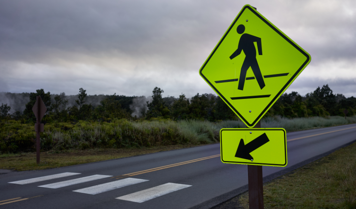
6 best practices for commercial drivers
Pedestrian injury can occur anywhere, from a bustling downtown area to rural roads without sidewalks. Use these best practices to help reduce potential risk and keep everyone safer:
1. Follow standard safe driving practices.
Defensive driving is your first safeguard. Maintain safe speeds, leave adequate following distance and stay vigilant of your surroundings. The Federal Motor Carrier Safety Administration (FMCSA) recommends scanning approximately 15 seconds ahead of the vehicle — about a quarter mile on the interstate or one to two city blocks — and checking mirrors every 8-10 seconds. Consistent scanning gives you more time to recognize and respond to pedestrians and cyclists who may in your blind spots.
2. Assume that pedestrians don’t know how your vehicle moves.
Most pedestrians and cyclists do not recognize that a truck’s blind spots extend up to 20 feet in front of the cab, along both sides of the truck and as much as 30 feet behind the trailer. A pedestrian may think that you can see them, simply because they can see you.
Before changing lanes, turning or pulling away from a stop, use your mirrors — including convex mirrors — to monitor blind spots and verify that you’re in the clear. Always assume that pedestrians and cyclists may enter these areas without realizing that you cannot see them.
3. Focus on the trailer, not just the cab.
As the earlier example demonstrates, it’s not uncommon for pedestrian crashes to happen after the cab has successfully cleared an intersection — but before the trailer. During a right-hand turn, trailers often swing toward the curb and may inadvertently strike pedestrians. Continuously check your mirrors throughout the entirety of the turn, ensuring that the trailer fully clears the intersection, crosswalk and sidewalk before accelerating again.
4. Expect unpredictable behavior.
Never assume pedestrians will stop, yield, make eye contact or hear your truck approaching. Phones, earbuds and other distractions reduce situational awareness. Cyclists may suddenly move into a truck’s blind spot without realizing it. Defensive driving means recognizing unexpected actions and giving yourself the time and space to react safely.
5. Slow down in pedestrian-heavy or urban areas.
Urban roads, delivery districts, school zones, construction areas and retail centers increase a driver’s exposure to pedestrians. When driving in these congested areas, be extra vigilant and scan mirrors frequently to double-check your blind spots. Remember that lower speeds in crowded areas offer you additional reaction time, a critical tool to reduce risk.
6. Plan routes with pedestrian risk in mind.
Always review your entire route before you head out. If possible, select a route that minimizes high-traffic areas, such as tight city turns, congested downtown corridors, school zones or areas with heavy foot traffic. While high-traffic areas aren’t always unavoidable, sticking to wider streets with fewer pedestrians can help reduce the likelihood of an accident.
ASK A LOSS CONTROL REPRESENTATIVE
Have a question on how to mitigate risk? Email losscontroldirect@iatinsurance.com for a chance to see your question answered in a future blog.


